
In Singapore’s heat and humdity, having an air-con isn’t just nice; it’s a need. Buying a used aircon is a good way to save cash, but only if you check it thoroughly before buying. Let’s discover the top 5 consideration before purchasing a 2nd hand aircon in Singapore so you don’t end up with losing money.
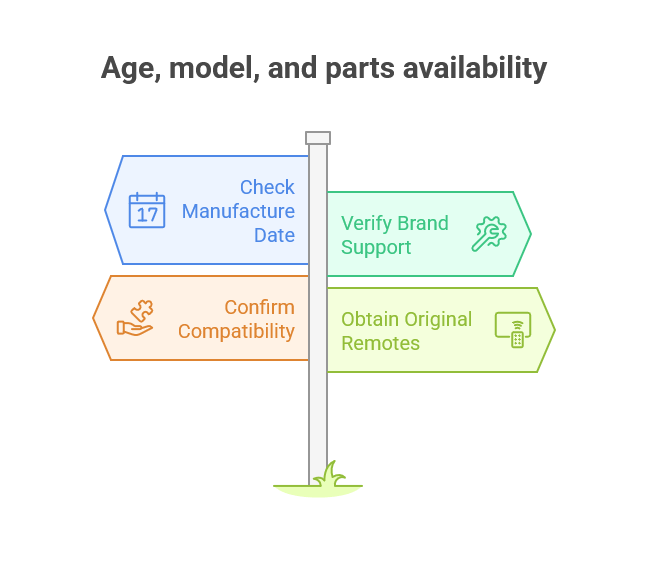
Age, model, and parts availability
Manufacture date & usage:
Get the serial number of the unit and check the year made. Most wall-mounted split systems are good for 8 to 12 years if serviced on time. If it’s older than 8 years, only pay a cheap price and make sure there’s a full service record.
Brand & model support in SG:
Make sure spare parts of the unit—like the PCB, fan motor, blower, and sensors—are easily available in Singapore. Models that been discontinued or that are made for other countries should not be considered as you will not find spare parts if necessary in the future.
Multi-split compatibility:
Outdoor and indoor units must be matched (same brand/model family) within the approved pairings. Mixing brands or incompatible series is risky and often unserviceable. So, keep this in mind.
Controller & remotes:
Confirm you’re getting the original remote(s). Universal remotes may not expose all functions or error codes.
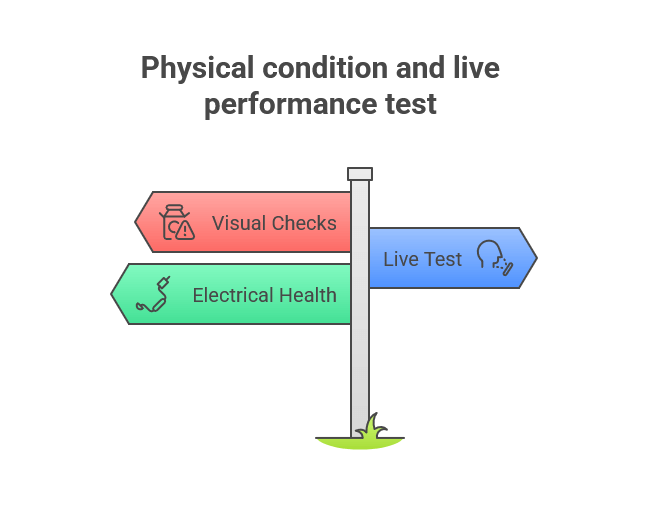
Physical condition and live performance test
In this step, inspect first, then run the unit for at least 15–20 minutes.
Visual checks
Indoor unit: Look for cracked plastic, missing louvers, damaged fins, mold around the blower, and signs of harsh chemical wash (bent aluminum fins).
Outdoor condenser: Check for corrosion on coil fins and frame (especially in coastal blocks), oil stains around service valves (may indicate leaks), brittle or swollen insulation on copper pipes, rusted brackets/drip tray.
Trunking & drain: UV-damaged trunking, poor sealing, or stained walls can signal leaks. A clogged drain line will cause indoor drips.
Live test (cooling & noise)
Live testing the unit before confirming is a good idea to confirm whether the unit is in working condition. If possible, test the unit live. At least do it in front of the installer right after installation.
Set the thermostat to 18–20°C and the fan to high, then close all doors and windows.
You should feel powerful, with even airflow. After 10 minutes, measure the air temperature at the louver with an infrared thermometer and expect a difference of 8–12°C cooler than the room temperature.
Listen for unusual sounds like rattles or grinding. The outdoor compressor should hum steadily and feel smooth without harsh vibrations.
Check for any water leakage. Check the indoor unit for blinking error lights or codes.
Electrical health (quick, non-technical checks)
Confirm the nameplate voltage/current (most are 230V) and that the plug/circuit looks intact (no heat discoloration). A licensed installer can later verify running amperage against specs.
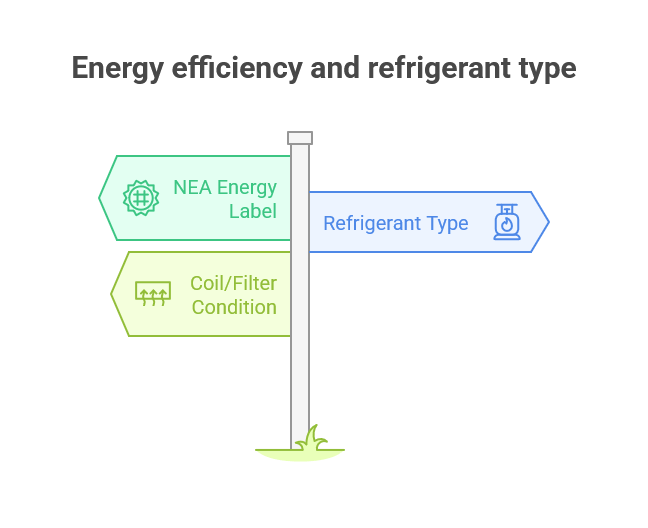
 Energy efficiency and refrigerant type
NEA energy label & ticks:
More ticks = better efficiency. Check the tick rating. If the sticker is missing, search the model’s CSPF online or ask the seller for documentation/photos.
Refrigerant:
In Singapore, there are a few different types of aircon refrigerant gases used. Prefer R32 (newer, generally more efficient) or R410A (still common). Avoid old R22 units—phase-out means parts/refrigerant are problematic.
Coil/filters condition:
A “clean” unit that hasn’t had a harsh chemical burn will be quieter, cooler, and cheaper to run. Check that washable filters are present and intact.
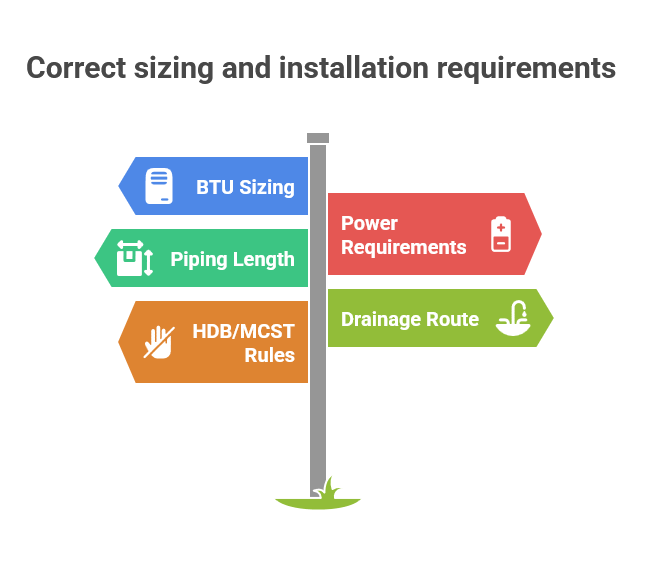
 Correct sizing and installation requirements for your home
Right BTU for your room (typical HDB/condo ceiling heights):
14–23 m² → ~9,000 BTU
23–32 m² → ~12,000 BTU
32–42 m² → ~18,000 BTU
You can know more about the right aircon size in Singapore from our blog.
Installation fit
- Power: Ensure a dedicated circuit and appropriate breaker per the nameplate. Don’t overload a multi-way extension for a casement/portable unit.
- Piping length & elevation: Long runs may need extra refrigerant; very short runs can cause noise/oil return issues. Ask your installer to confirm limits for your model.
- Drainage route: Must flow by gravity to a proper outlet; pumps add cost/maintenance.
- HDB/MCST rules: Check allowed condenser locations, façade restrictions, noise limits, and water discharge. Re-use of existing brackets may be barred if corroded; some MCSTs require fresh brackets and proof of professional installation.
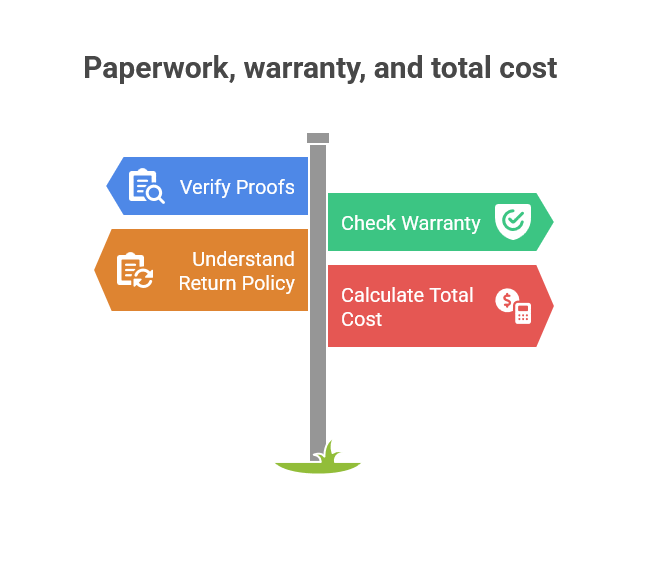
 Paperwork, warranty, and total cost to own
- Proofs: Request the seller original invoice, service records (general/chemical wash dates), and any repair receipts (PCB/compressor).
- Warranty: Reconditioned aircon sellers in Singapore offer a few month of warranty for the unitss (at least 3–6 months). Clarify what’s covered: compressor, PCB, fan motor, gas leaks, transport/labour.
- Return/DOA policy: Get it in writing—especially for units bought from private sellers or Carousell listings.
- All-in cost view: Reconditioned aircon price + dismantling + transport + re-installation + new copper pipes/insulation/trunking + gas top-up + brackets + first general service. Cheap units often become expensive after these must-dos.
 Quick pre-purchase checklist for reconditioned aircon
Before finalizing the purchase, you must check below points:
- Brand/model and year of manufacture confirmed
- Matching indoor/outdoor units (for multi-split)
- Visuals: no severe rust, oil stains, brittle pipe insulation, or cracked plastics
- Live test 15–20 min: strong airflow, good cooling, no abnormal noise, no indoor drips
- No blinking error codes; remote works; flaps swing properly
- NEA label seen or efficiency verified; refrigerant is R32 or R410A
- BTU fits my room size and sun exposure
- Condo/HDB rules checked for condenser placement & noise
- Installer confirmed power, piping route, drain route, bracket condition
- Service records provided; warranty/DOA policy in writing
- Total cost (unit + install + materials + first service) fits budget
Red flags—walk away if you see these
- Persistent metallic knocking, grinding, or screeching (fan/compressor issues)
- Oil around service valves or flare joints (likely refrigerant leak)
- Significant condenser frame/coil rust or fins turning to powder
- Indoor unit moldy smell that persists after filter cleaning (deep blower/mold issue)
- Seller refuses a live test or cannot show model/serial labels
- R22 systems, or mismatched multi-split combinations
Private seller vs “reconditioned” shop—what’s better?
- Private seller: Lower price, but buyer beware. Usually no warranty, unknown handling during dismantle/transport, and uncertain parts life.
- Reconditioned shop: Higher price, but typically cleaned, pressure-tested, and sold with short warranty. Ask what parts were replaced and insist on a written checklist of what “reconditioned” means. Always rely on the top aircon installers in Singapore for purchasing used aircon.
Check Our Reconditioned Aircon Units?
Best price and quality assured. Contact us for free site visit. Get a free quotation instantly.
Reconditioned Aircon SingaporeFAQs
Is buying a used aircon worth it in Singapore?
Yes—if the unit is relatively new (ideally under ~6–7 years), efficiently rated, well-maintained, and you’ve budgeted for proper re-installation. If you want predictability, a reconditioned unit with a real warranty is safer.
What’s the single most expensive surprise with used units?
Electronics (PCB) and compressor failures. That’s why a long, quiet live test and proof of past repairs are crucial.
Can I move a multi-split system from another flat?
Possible, but tricky. The outdoor unit size and approved pairing limits matter, and the new piping routes/lengths must be within spec. Get an experienced installer to evaluate first.
Do I need permission to install or move a condenser?
HDB and most MCSTs have rules on placement, appearance, noise, and drainage. Always check with your Town Council/MCST before drilling or mounting brackets.
How soon should I service after buying used?
Immediately after installation: request a general service (clean filters/coil/blower, flush drain, check gas pressure) so you start with a known baseline.